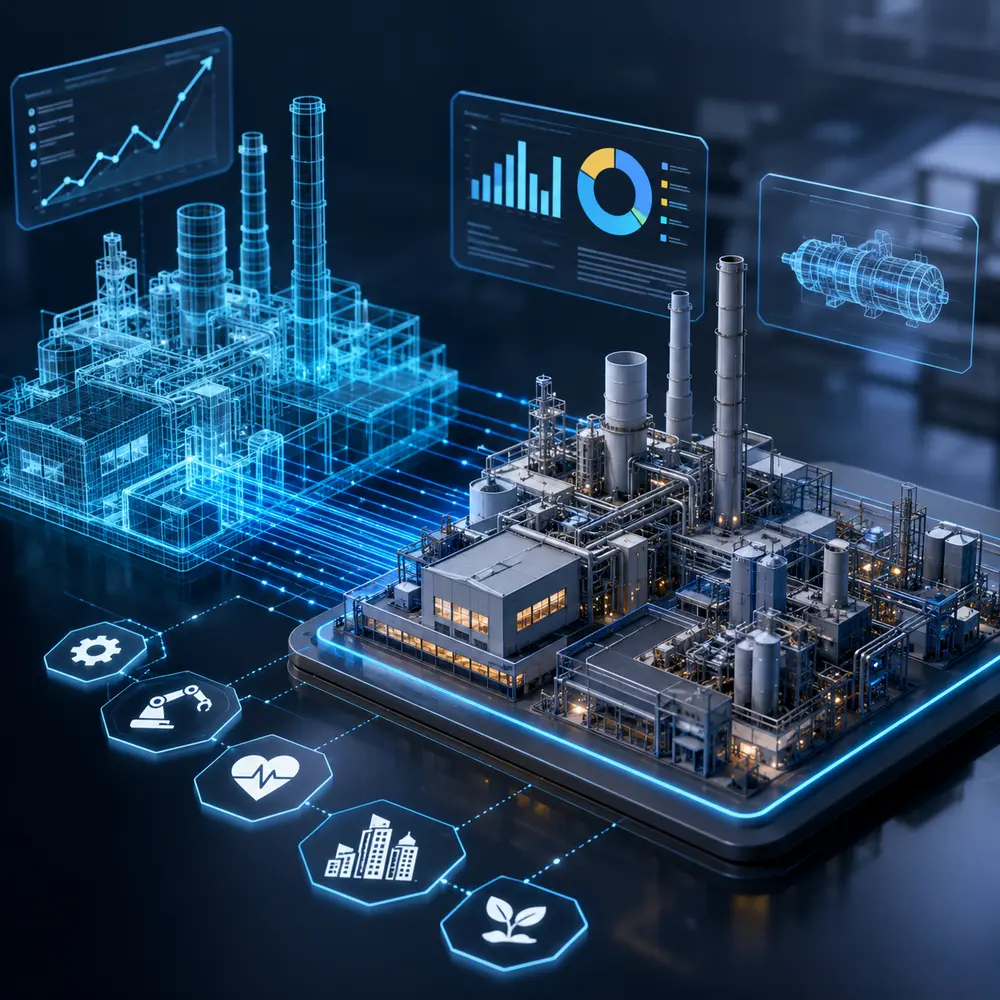
Digital twin technology is reshaping how businesses, cities, and hospitals operate today. At its core, a digital twin is a virtual copy of a real-world object, system, or process that stays connected to its physical counterpart through live data. Whether it is a factory machine, a hospital patient, or an entire smart city, digital twin technology lets teams monitor, simulate, and improve performance without touching the physical thing at all.
In 2026, the digital twin market is valued at nearly $39.75 billion and is on track to surpass $122 billion by 2030. If you have been hearing this term more often lately, there is a good reason. Industries around the world are using digital twin technology to cut costs, prevent failures, and make faster decisions. This guide breaks down everything you need to know, from the basic definition to real-world digital twin examples across key industries.
What Is a Digital Twin? A Simple Definition
A digital twin is a virtual representation of a physical object or system. It receives real-time data from sensors and connected devices, which keeps the virtual model perfectly in sync with what is happening in the real world. Think of it like a living mirror of a physical asset that you can watch, test, and change without any risk to the actual thing.
The concept was first explored by NASA to monitor spacecraft systems remotely. Today, digital twin technology has moved far beyond aerospace. It sits at the center of industrial IoT, smart city planning, simulation technology, and even personalized healthcare.
A digital twin typically has three key parts:
- The physical asset — the real machine, building, or system being mirrored
- The virtual model — the digital copy that receives and processes data
- The data connection — sensors, IoT devices, and software that keep both sides in sync
How Does Digital Twin Technology Work?
Digital twin technology works by combining several powerful technologies into one connected system. Here is a simple step-by-step look at how it functions:
Step 1: Data Collection via IoT Sensors
Physical assets are fitted with IoT sensors that collect data continuously. These sensors track temperature, pressure, speed, location, performance, and dozens of other metrics depending on the industry. This is the backbone of the IoT digital twin — without real-time data, the virtual model is just a static picture.
Step 2: Data Transmission to the Virtual Model
The sensor data travels over networks — increasingly through 5G — to the digital twin platform hosted in the cloud or on-premise systems. Faster networks mean near real-time synchronization, which makes the digital twin more accurate and useful.
Step 3: AI-Powered Analysis and Simulation
Once the data reaches the virtual model, artificial intelligence and machine learning algorithms analyze it. The digital twin does not just show what is happening right now. It also runs simulations to predict what might happen next. This predictive power is one of the biggest reasons businesses are investing heavily in digital twin technology.
Step 4: Actionable Insights and Decision Support
Teams use the insights from the digital twin to make decisions — adjusting processes, scheduling maintenance before a breakdown happens, or testing a new design before building it physically. Companies using digital twins report up to a 90% improvement in decision-making speed and a 65% reduction in unplanned downtime.
Types of Digital Twins
Not all digital twin technology is the same. Here are the main types used across industries:
- Component/Part Twin — models a single component, like a turbine blade or a pump valve
- Asset Twin — models a complete asset made up of multiple components, like an aircraft engine
- System Twin — models how multiple assets interact with each other inside a larger system
- Process Twin — models an entire workflow or process, like a manufacturing production line or a hospital emergency department
Digital Twin Examples Across Key Industries
Looking at real digital twin examples helps make the technology much easier to understand. Here is how different sectors are using it in 2026.
Digital Twin in Manufacturing
Digital twin manufacturing is the most advanced and widely adopted application of this technology. Factories use digital twin technology to create virtual copies of entire production lines. Engineers can test new configurations, identify bottlenecks, and run maintenance simulations without stopping real production.
One of the strongest digital twin examples in manufacturing is PepsiCo, which is using Siemens Digital Twin Composer to simulate upgrades to its US manufacturing and warehouse facilities. The company reports identifying up to 90% of potential issues before any physical construction begins — saving enormous amounts of time and capital.
Digital twin manufacturing also powers predictive maintenance. When sensors detect early signs of wear or stress on a machine, the digital twin flags the issue. Maintenance teams fix the problem before a costly breakdown occurs. Companies using this approach report up to a 79% reduction in maintenance costs.
IoT Digital Twin in Energy and Utilities
The IoT digital twin is transforming energy management. Utilities use virtual replicas of transformers, substations, and entire power grids to simulate how the network will respond to demand spikes, storms, or equipment failures. The European Union has funded TwinEU, a €25 million project building a digital twin of the entire European electricity grid.
In renewable energy, companies use IoT digital twin platforms to monitor wind turbines and solar farms in real time. An IoT digital twin for wind turbines can predict blade wear, optimize rotation angles, and schedule maintenance during low-wind periods, maximizing energy output without risking damage.
Siemens Digital Twin
When discussing leading digital twin technology, Siemens consistently stands out as one of the most advanced players in the space. The Siemens digital twin ecosystem is built around its Xcelerator platform, which includes over 1,700 solutions spanning software, IoT-enabled hardware, and digital services.
At CES 2026, Siemens launched its groundbreaking Digital Twin Composer software. This tool builds Industrial Metaverse environments at scale, combining 2D and 3D digital twin data with real-time physical information in a photorealistic visual scene powered by NVIDIA Omniverse. The Siemens digital twin approach lets companies run the full “design, simulate, deploy, optimize” cycle entirely in the virtual world before committing to physical changes.
Siemens also expanded its partnership with NVIDIA at CES 2026 to build the Industrial AI Operating System, further embedding AI into every step of the industrial value chain through its digital twin platform. This makes the Siemens digital twin one of the most comprehensive simulation technology platforms available today.
Digital Twin Healthcare
Digital twin healthcare is one of the fastest-growing and most exciting areas of this technology. In this sector, digital twin technology creates virtual replicas of patients, organs, hospital workflows, and even entire clinical environments.
Here are some of the most promising digital twin examples in healthcare:
- Patient Digital Twins — Wearables and IoT sensors collect data on a patient’s heart rate, glucose levels, and blood pressure in real time. This data feeds a digital twin that doctors can use to simulate how a patient will respond to a specific drug or treatment before prescribing it.
- Surgical Planning — Surgeons use digital twin technology to practice complex procedures on a virtual replica of the patient’s anatomy before entering the operating room.
- Hospital Operations — Digital twin healthcare extends to simulating patient flow, bed availability, and staff scheduling to reduce wait times and improve care quality.
- Drug Development — Pharmaceutical companies use digital twins to simulate biological processes and drug interactions, speeding up clinical trials and reducing the need for costly physical testing.
Duke University’s Center for Computational and Digital Health Innovation is actively using digital twin healthcare tools to model cardiovascular blood flow and predict surgical outcomes with greater precision. Experts predict the digital twin healthcare market will become a multibillion-dollar industry before the end of this decade.
Digital Twin in Smart Cities
Digital twin technology is playing a key role in building smarter, more sustainable urban environments. Smart city digital twins connect thousands of IoT sensors across a city to monitor traffic, air quality, energy use, water systems, and public infrastructure in real time.
Virtual Singapore is one of the most well-known smart city digital twin examples. It gives city planners a live, data-driven model of the entire city that supports real-time urban management and optimized transportation planning. City officials can simulate how a new building will affect traffic, sunlight, or drainage before a single brick is laid.
In 2026, smart city digital twin projects are expanding rapidly as governments invest in digital infrastructure. The UK’s National Digital Twin Programme (NDTP) is one government-led initiative designed to scale national capabilities in digital twin technology across public services and infrastructure.
Key Benefits of Digital Twin Technology
The rapid adoption of digital twin technology is driven by clear, measurable benefits. Here is what organizations are experiencing:
- Predictive Maintenance — Digital twins detect equipment issues early, reducing unexpected breakdowns and cutting maintenance costs significantly.
- Faster Product Development — Engineers can test and refine designs in the virtual world, eliminating the need for multiple costly physical prototypes. Simulation technology speeds up the path from concept to market.
- Reduced Downtime — With real-time monitoring, teams can address performance issues before they escalate. Companies report a 65% reduction in unplanned downtime after deploying digital twin technology.
- Better Decision Making — Having a live, data-rich virtual model means decisions are based on facts, not guesses. Organizations see up to a 90% improvement in decision-making cycles.
- Cost Savings — Whether in digital twin manufacturing, healthcare, or energy, reducing physical testing and preventing failures leads to 79% of organizations reporting notable cost savings.
- Sustainability — Digital twins help organizations reduce energy waste, optimize resource use, and lower their carbon footprint without sacrificing performance.
Challenges and Limitations of Digital Twin Technology
Digital twin technology is powerful, but it is not without its challenges. Organizations should be aware of these before investing:
- High Initial Costs — Building a reliable digital twin requires investment in sensors, connectivity, cloud infrastructure, software platforms, and skilled staff. For smaller businesses, these upfront costs can be a significant barrier.
- Data Security Risks — Because digital twins rely on continuous real-time data flows, they create new cybersecurity vulnerabilities. A breach could expose sensitive operational or patient data, especially in industrial IoT and digital twin healthcare environments.
- Data Management Complexity — Digital twins generate enormous amounts of data. Managing, storing, and analyzing that data accurately requires robust systems and expertise.
- Keeping Models Updated — A digital twin is only useful if it stays accurate. As physical assets change or evolve, the virtual model must be updated continuously. Without proper maintenance, the twin becomes unreliable.
- Scalability Issues — Scaling digital twin technology from a single machine to an entire factory or city introduces technical and organizational complexity that requires careful planning.
The Future of Digital Twin Technology
The future of digital twin technology looks extraordinary. Several powerful trends are shaping where this technology is heading in 2026 and beyond.
Self-Healing and Autonomous Digital Twins
One of the most exciting developments in 2026 is the rise of self-healing digital twins. These AI-powered models can detect when their own data is inconsistent or when a sensor has failed, and automatically fill gaps using historical patterns and predictive logic. This means the digital twin stays reliable even when physical hardware fails.
AI and Generative Models
Generative AI is taking digital twin technology to a new level. Instead of simply monitoring current performance, AI-powered twins can now simulate thousands of possible future states in the background. This “what-if engine” capability gives teams an unprecedented ability to test decisions before committing to them in the real world.
Industrial IoT and 5G Integration
The expansion of industrial IoT and 5G networks is dramatically improving the speed and accuracy of digital twins. Near real-time data transmission means the virtual model is always tightly synchronized with the physical asset. This is especially important for applications like autonomous vehicles, smart city management, and digital twin manufacturing.
Digital Twins in the Industrial Metaverse
The concept of the industrial metaverse — where physical and digital worlds merge into a shared, immersive environment — is becoming real. Platforms like the Siemens digital twin Composer and NVIDIA Omniverse are at the center of this shift. Workers in different parts of the world will be able to collaborate inside a shared, photorealistic digital twin of a factory or infrastructure project simultaneously.
Digital Twin Technology vs. Traditional Simulation
Many people confuse digital twin technology with traditional simulation technology. Here is a simple way to tell them apart:
- Traditional Simulation — runs based on fixed assumptions and historical data. It is not connected to the real world in real time. It is a one-time analysis tool.
- Digital Twin — is always connected to the real asset through live data. It updates automatically, reflects current conditions, and can simulate future states based on what is actually happening right now.
This constant real-time connection is what makes digital twin technology so much more powerful than traditional simulation in operational environments.
Conclusion
Digital twin technology is no longer a futuristic concept. It is a real, working tool that is already transforming digital twin manufacturing, digital twin healthcare, industrial IoT networks, and smart city infrastructure around the world. With the market set to reach over $122 billion by 2030, the momentum behind this technology is undeniable.
From the Siemens digital twin Composer launched at CES 2026 to digital twin examples in hospitals and power grids, the evidence is clear — organizations that adopt digital twin technology today will be better positioned to compete, innovate, and operate efficiently tomorrow. Whether you are a business leader, a developer, or simply someone curious about where technology is headed, now is the perfect time to explore what digital twin technology can do for you.