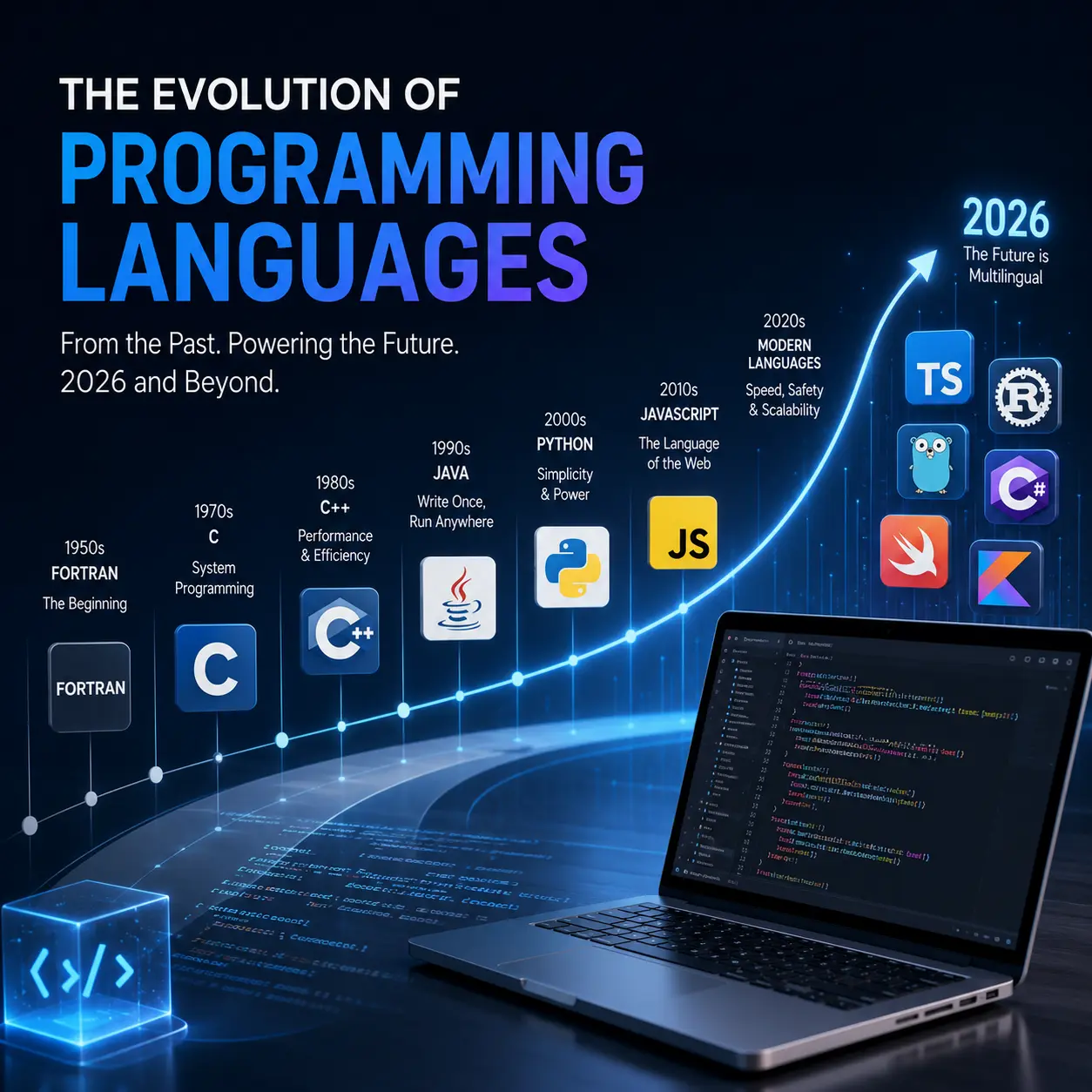
The tech industry shifts rapidly, and understanding the core programming languages used today is vital for success. Whether you want to build websites, design complex artificial intelligence models, or create high-speed financial systems, learning the right tools gives you a massive advantage. In 2026, the digital world relies on a mix of highly reliable classic systems and extremely fast, modern tools. The evolution of programming languages has completely changed how developers write software. Code is now safer, faster, and much more scalable. In this detailed guide, we will explore the history, current trends, and real-world applications of the most important coding tools. We will also help you understand which programming languages are worth your time this year.
The Early History and Evolution of Programming Languages
The evolution of programming languages began decades ago with very simple instructions. Early systems required developers to write code using punch cards and basic machine language. This was a slow process that required deep knowledge of hardware. Soon, early programming languages like Fortran and C were created. These allowed humans to write code using readable text instead of raw numbers. This was a massive step forward for computer science.
During the 1990s, the internet boom changed everything. Developers needed ways to build interactive websites and complex corporate software. This era introduced Java and JavaScript, which remain heavily used today. Over time, programming languages became more human-readable and focused on developer productivity. The goal shifted from just controlling hardware to solving real business problems quickly.
Today in 2026, the landscape looks very different. The focus is no longer just on web development. Cloud computing, machine learning, and data security drive the market. We now see a high demand for tools that handle massive amounts of data without crashing. The modern era of programming languages focuses on type safety, memory management, and artificial intelligence integration.
Top Programming Languages Dominating 2026
Many programming languages exist today, but only a select few dominate the professional job market in 2026. Let us look at the programming languages leading the tech industry right now.
Python: The Undisputed King of Data and AI
Python stands out among other programming languages for its incredible simplicity and clear syntax. It reads almost like plain English. This makes it perfect for beginners, but its true power lies in its massive ecosystem. In 2026, Python is the default choice for artificial intelligence, machine learning, and data science. Tools like TensorFlow, PyTorch, and Pandas rely entirely on Python.
Developers also use Python heavily for backend web development and automated scripting. Frameworks like Django and Flask allow teams to launch web applications quickly. While Python is not the fastest language for execution speed, developer productivity makes up for it. When companies need to process data or build AI workflows, Python is the first tool they pick.
JavaScript and TypeScript: Ruling the Modern Web
When comparing web-focused programming languages, JavaScript is absolutely essential. It is the only language that runs natively inside every web browser. JavaScript powers the interactive parts of almost every website on the internet today. Furthermore, environments like Node.js allow developers to use JavaScript on the backend as well.
However, as applications grow larger, regular JavaScript can cause unpredictable bugs. This is why TypeScript has become the industry standard in 2026. TypeScript adds strict type safety to JavaScript. It catches errors before the code even runs. Today, major web frameworks like React, Angular, and Vue rely heavily on TypeScript to keep large codebases stable and maintainable.
Go and Rust: The Cloud and Systems Powerhouses
System-level programming languages require high security and blazing fast performance. This is exactly where Go and Rust shine in 2026. Go, also known as Golang, was created by Google. It is designed to handle multiple tasks at the exact same time through a feature called goroutines. Because of its speed and simplicity, Go is the top choice for cloud infrastructure. Huge platforms like Docker and Kubernetes are built with Go.
Rust, on the other hand, solves a different problem. It focuses on absolute memory safety without slowing down the software. Traditional languages often suffer from memory leaks, which lead to security hacks. Rust prevents these bugs entirely. Because of this, developers now use Rust for secure systems, web browsers, and even operating system kernels.
Java and C#: The Enterprise Anchors
Enterprise programming languages need to be stable, secure, and highly scalable. Java and C# continue to rule the corporate world in 2026. Java runs on the Java Virtual Machine, meaning it works on any operating system. It is deeply embedded in massive banking systems, credit card processors, and Android mobile applications. It is incredibly reliable for large teams.
C# was created by Microsoft and remains incredibly popular. It combines great performance with developer-friendly tools. Developers use C# to build Windows desktop applications, enterprise web software, and video games. The Unity game engine runs entirely on C#, making it a mandatory skill for many aspiring game developers today.
C and C++: Unmatched Speed and Performance
Despite being older, C and C++ remain critical in 2026. These tools offer direct control over computer memory and hardware. This makes them extremely fast. Developers use C++ to build the core systems where every millisecond matters. This includes high-frequency trading platforms, graphics engines, and real-time simulations.
The Unreal Engine, which powers many of the most realistic video games and virtual reality experiences today, runs on C++. C is still heavily used for programming embedded systems. This includes smart home devices, car computers, and factory machines.
Real-World Applications of Top Programming Languages
Different programming languages solve vastly different problems in the real world. Choosing the right programming languages ensures that a project is successful from day one. Here is how companies apply these tools in 2026:
- Artificial Intelligence: Companies building smart chatbots, predictive text, and image generators rely almost entirely on Python.
- Web Applications: E-commerce stores, social media dashboards, and streaming services use a combination of TypeScript, React, and Node.js.
- Cloud Services: Modern cloud hosting providers use Go to manage server loads and route web traffic efficiently.
- Video Games: Mobile games are often built with C# and Unity, while massive console games use C++ and Unreal Engine.
- Financial Banking: Global banks still trust Java to process millions of secure transactions every single day.
Pros and Cons of Popular Programming Languages
Every developer knows that all programming languages have specific trade-offs. No single tool is perfect for every job. Selecting between these programming languages depends entirely on your project goals.
- Python: The main pro is its easy syntax and massive library support for AI. The con is that it runs slower than compiled languages.
- JavaScript/TypeScript: The pro is universal support across all web browsers and full-stack capabilities. The con is that the ecosystem changes rapidly, which can overwhelm beginners.
- Rust: The pro is perfect memory safety and incredible speed. The con is a very steep learning curve for new developers.
- Go: The pro is amazing cloud performance and easy concurrency. The con is that its strict simplicity can limit complex design patterns.
- C++: The pro is ultimate control over hardware and speed. The con is that manually managing memory can easily lead to critical bugs.
Future Trends for Programming Languages Beyond 2026
The tech industry never stands still. The next generation of programming languages will continue to evolve rapidly. One major trend in 2026 is the heavy integration of artificial intelligence directly into code editors. AI tools now help developers write basic code, find hidden bugs, and suggest better syntax. This means future languages might become even simpler to read.
Another big trend is WebAssembly. This technology allows developers to run high-performance languages like Rust and C++ directly inside a web browser at near-native speeds. This blurs the line between traditional desktop software and online web applications. As quantum computing begins to grow, we will also see the rise of entirely new tools built specifically for quantum mechanics.
Conclusion
The world of software development is constantly shifting. The evolution of programming languages proves that technology never stops adapting to new challenges. From the rise of Python in the artificial intelligence sector to the dominance of Rust in secure systems, 2026 offers incredible opportunities for developers. Whether you are building simple web pages or massive cloud networks, mastering the right tools is the key to success. Keep exploring new programming languages to stay ahead, build better applications, and future-proof your digital career.
Frequently Asked Questions (FAQs)
What are the best programming languages to learn in 2026?
The best choices depend on your career goals. Python is the best choice for data science and AI. TypeScript is mandatory for modern web development. If you want to work in cloud computing, you should learn Go. For high-performance game development, C++ and C# are the top picks.
How do I choose between different programming languages?
You should choose based on the specific project you want to build. Look at what the industry standard is for that domain. If you want to build an iOS mobile app, you use Swift. If you are analyzing a huge spreadsheet of customer data, Python is the right tool. Pick the language that offers the best libraries for your exact needs.
Is JavaScript still relevant in 2026?
Yes, JavaScript remains highly relevant. It is still the foundational language of the web. However, most professional teams now use TypeScript, which is essentially a safer, more structured version of JavaScript. Knowing how JavaScript works under the hood is still a required skill for any web developer.
Why are Go and Rust becoming so popular?
Go and Rust are incredibly popular because they solve modern infrastructure problems. As companies move to the cloud, they need software that uses less server memory and runs very fast. Go handles cloud networking perfectly. Rust prevents security vulnerabilities and crashes, making it ideal for systems where failure is not an option.