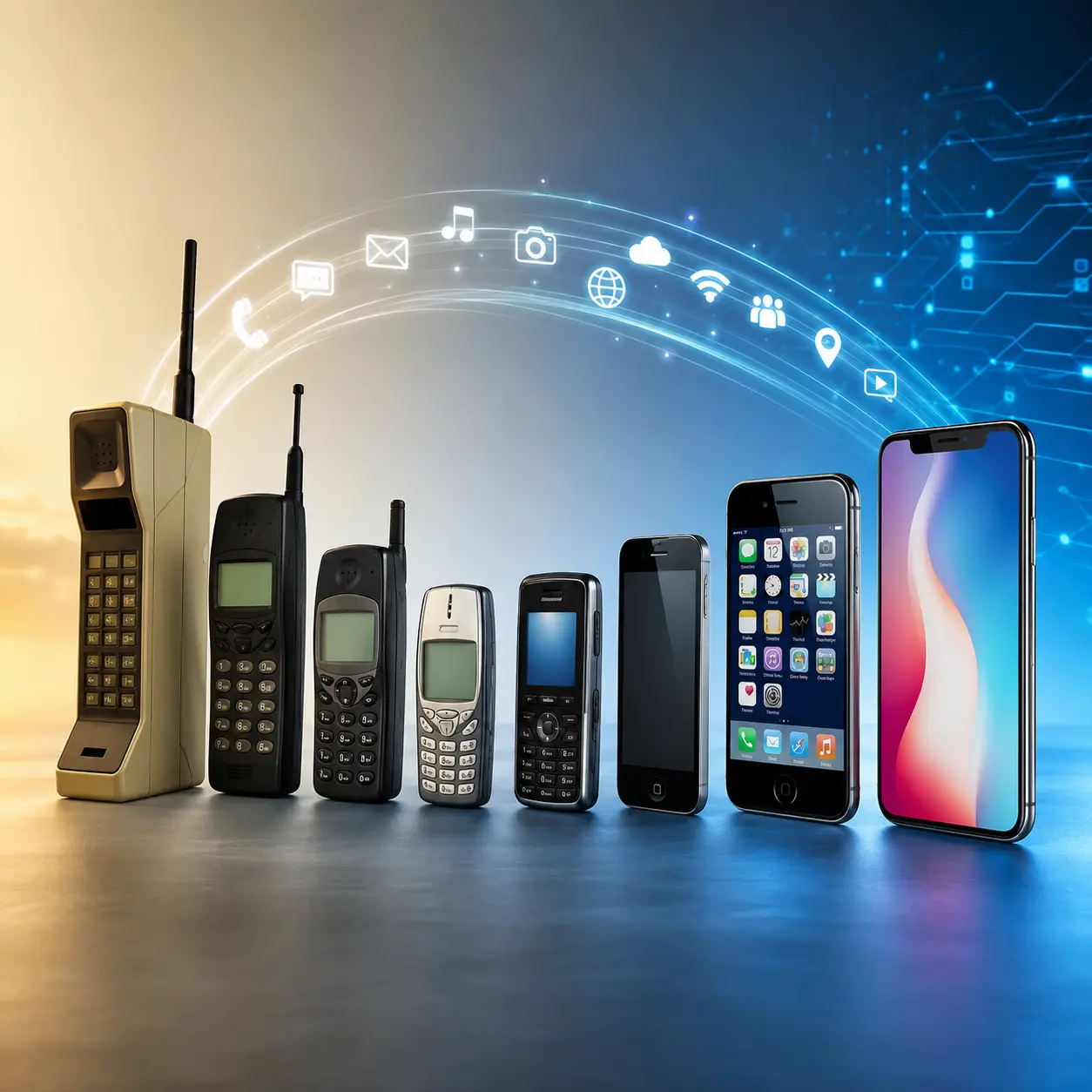
The mobile phone is one of the most life-changing inventions in human history. Today, in 2026, more than 5.78 billion people across the world use a mobile phone every single day. From a simple telephone call to a touch screen powered smart device, the revolution of mobile is something every person has witnessed in their own lifetime. This article explains the full history of mobile phone, how mobile phone was introduced, and how this small device changed the entire world.
If you have ever wondered how a heavy telegram machine slowly turned into the slim touch screen mobile phone sitting in your pocket right now, you are in the right place. We will walk through every important stage of the mobile phone journey, in simple and easy words, so that even a beginner can understand this exciting story.
What Is a Mobile Phone?
A mobile phone is a wireless communication device that allows people to make calls, send messages, and access the internet without being connected to any wire. Unlike the old telephone, which needed a fixed cable, a mobile phone uses radio signals and cellular networks to connect with other devices.
In simple words, a mobile phone gives you freedom. You can talk to anyone, anywhere, anytime. This is the basic reason why the revolution of mobile happened so fast across the globe.
How Mobile Phone Was Introduced: The Early Beginning
Before understanding how mobile phone was introduced, we need to understand the telephone first. The telephone was invented by Alexander Graham Bell in 1876. This device used wires to send voice signals from one place to another. For many decades, the telephone remained fixed at one location, usually a home or an office.
Along with the telephone, another communication method called the telegram was widely used. The telegram allowed people to send short written messages using electrical signals over long distances. The telegram was fast for its time, but it could not carry voice, and it required trained operators to send and receive messages. Both the telephone and the telegram were important steps that led toward the idea of a mobile phone. In many ways, the telegram was the ancestor of the text message we now send from a mobile phone.
Early Wireless Experiments
The real story of the mobile phone begins much earlier than most people think.
- In 1908, a wireless telephone device was claimed in the United States, although it was never manufactured commercially.
- In 1926, train passengers in Germany were offered the first mobile telephony service between Berlin and Hamburg.
- In 1946, Bell Labs in the United States launched the Mobile Telephone Service, allowing calls from cars for the first time.
These early systems were heavy, expensive, and limited to a small number of users. But they planted the seed for the mobile phone revolution that was about to come.
The Birth of the True Mobile Phone (1973)
The most important moment in the history of mobile phone happened on April 3, 1973. Motorola engineer Dr. Martin Cooper made the world’s first handheld mobile phone call. He called his rival at Bell Labs while standing on a street in New York City.
This single call marked the official start of the mobile phone revolution. It proved that a mobile phone, separate from a car or a fixed telephone, could actually exist and work in real life.
The Motorola DynaTAC 8000X
In 1983, Motorola launched the DynaTAC 8000X, which became the first commercially available mobile phone. Some key facts about this device:
- It weighed nearly 1.1 kg, almost like holding a small brick.
- The battery lasted only 30 minutes of talk time.
- It cost around 4,000 US dollars at that time.
- It could only store 30 contacts.
Even with these limitations, the DynaTAC 8000X became a status symbol. People saw it as the future of communication, and the mobile phone revolution had truly begun.
The Growth of Mobile Networks: 1G to 5G
The history of mobile phone is closely linked to the development of mobile networks. Each new generation of network brought faster speed and smarter features to the mobile phone.
1G: The First Generation
The first generation network, known as 1G, was launched in the early 1980s. It allowed voice calls only, using analog signals. There was no text message, no internet, and call quality was often poor. Still, this was the network that powered the very first mobile phone.
2G: Digital Revolution and SMS
In 1991, the 2G network was launched, which converted analog signals into digital. This was a major step in the revolution of mobile because it allowed clearer voice calls and the introduction of text messaging. In December 1992, the first SMS text message, reading “Merry Christmas,” was sent. This small message changed the way the world communicates forever.
3G: Internet Comes to the Mobile Phone
By the early 2000s, 3G networks arrived, allowing the mobile phone to connect to the internet for the first time. This meant users could send emails, browse websites, and even make video calls. This stage of the history of mobile phone laid the foundation for the smartphone era.
4G: Speed and Streaming
4G networks, launched around 2009 to 2012, brought much faster internet speed to the mobile phone. This allowed smooth video streaming, online gaming, and high-speed downloads. The mobile phone was no longer just a calling device; it had become a complete entertainment and work tool.
5G: The Current Era
Today, in 2026, 5G is the leading mobile network technology. According to recent industry data, global 5G connections have already crossed 2.9 billion, representing nearly one-third of all mobile device connections worldwide. 5G offers incredibly fast speed, low delay, and supports new technologies like augmented reality, cloud gaming, and connected smart devices. Some reports even suggest that 5G networks now carry close to 38% of total global mobile internet traffic.
The Touch Screen Revolution
One of the biggest turning points in the revolution of mobile was the arrival of the touch screen. Before touch screen technology, mobile phones used physical buttons and small keypads for typing and navigation.
Early Touch Screen Devices
In 1999, IBM introduced an early touch screen device called the Simon Personal Communicator, which allowed users to send faxes and emails along with calls. Later, in 2007, the LG Prada became one of the first widely noticed touch screen mobile phones before Apple’s iPhone arrived.
The iPhone Changes Everything
In January 2007, Apple introduced the first iPhone. This device combined a mobile phone, a music player, and an internet device into a single touch screen gadget. The iPhone proved that a touch screen mobile phone could be both powerful and easy to use, even for someone with no technical background.
After the iPhone, almost every mobile phone manufacturer shifted toward touch screen designs. Buttons slowly disappeared, and touch screen became the new standard. This is one of the clearest examples of how the mobile phone revolution reshaped an entire industry within a few years.
Android and the Rise of the Smartphone Era
In 2008, Google launched the Android operating system, starting with the HTC Dream device. Android was open-source, meaning many companies could use and modify it freely. This made the mobile phone affordable for millions of people who could not buy an expensive iPhone.
As of mid 2026, Android continues to dominate the global market, holding around 70 to 72 percent share, while Apple’s iOS holds close to 27 to 28 percent. This balance between Android and iOS has shaped how billions of people use a mobile phone today.
Mobile Phone Statistics in 2026: How Big Is the Revolution?
The scale of the mobile phone revolution becomes clear when we look at the latest numbers. According to current industry reports:
- Over 5.78 billion people use a smartphone globally, which is about 70 percent of the world’s population.
- More than 7.58 billion mobile phones are currently active worldwide, more than the global human population.
- The average person spends close to 4 hours daily using their mobile phone.
- Global mobile app downloads have reached close to 299 billion in a year.
- 5G connections worldwide have surpassed 2.9 billion, and this number keeps rising every month.
- AI-powered mobile phones now account for around 25 percent of all new mobile phone sales.
- Foldable mobile phone shipments have grown rapidly, showing a major shift in mobile phone design.
These numbers clearly show that the revolution of mobile is not slowing down. It is actually speeding up, with new technology being added every year.
Real-World Applications of the Modern Mobile Phone
The mobile phone today is far more than a simple telephone replacement. It has become a central tool for almost every part of daily life.
Communication
Calling, texting, and video chatting have replaced the old telegram and traditional telephone systems almost completely.
Banking and Payments
Mobile banking apps now allow people to send money, pay bills, and manage accounts directly from their mobile phone, without visiting a bank.
Education and Learning
Students across the world use mobile phones for online classes, video lectures, and digital study material, especially in regions with limited access to computers.
Entertainment
From music streaming to mobile gaming, the mobile phone has replaced many separate devices like music players and gaming consoles.
Health Monitoring
Modern mobile phones, connected with smartwatches, can track heart rate, steps, and sleep patterns, helping users monitor their health every day.
Pros and Cons of the Mobile Phone Revolution
Advantages of Mobile Phone
- Instant communication with anyone, anywhere in the world.
- Access to unlimited information through the internet.
- Convenient mobile banking and online shopping.
- Touch screen design makes the device easy to use for all age groups.
- Helps in emergencies through quick calling and location sharing.
Disadvantages of Mobile Phone
- Excessive screen time can affect eyes and sleep quality.
- Risk of online scams and data privacy issues.
- Heavy dependence on mobile phone can reduce face-to-face communication.
- Old mobile phone devices contribute to electronic waste if not recycled properly.
Understanding both sides helps users enjoy the benefits of the mobile phone revolution while staying aware of its risks.
What Comes Next in the History of Mobile Phone?
The history of mobile phone is still being written. Industry experts are already working on 6G networks, expected around 2030, which promise speeds nearly 100 times faster than current 5G. New mobile phone designs, such as foldable and rollable screens, are also becoming more common.
Satellite connectivity is another exciting development, allowing a mobile phone to send messages even without a normal network tower, which can be a lifesaver in remote areas or emergencies. Artificial intelligence is also becoming a core part of mobile phone hardware, with many new devices now processing AI tasks directly on the mobile phone instead of relying only on the internet.
Conclusion: The Mobile Phone Revolution Continues
The journey from the heavy telegram and wired telephone to today’s slim touch screen mobile phone is truly remarkable. The revolution of mobile phone did not happen overnight. It took decades of research, failed experiments, and bold innovation to reach where we are today.
Understanding the history of mobile phone helps us appreciate how far technology has come and how much it has shaped our daily lives. As we move further into 2026 and beyond, the mobile phone will keep evolving, bringing new features and smarter experiences. If you enjoyed this journey through the history of mobile phone, keep exploring more about upcoming mobile phone trends, since this revolution of mobile is far from finished.